Dr. Md. Muzammel Hossain has successfully completed online training course “the Key Essentials: The Sustainable Development Goals and the Law” offered by Lucy Cavendish College and Hughes Hall at the University of Cambridge.
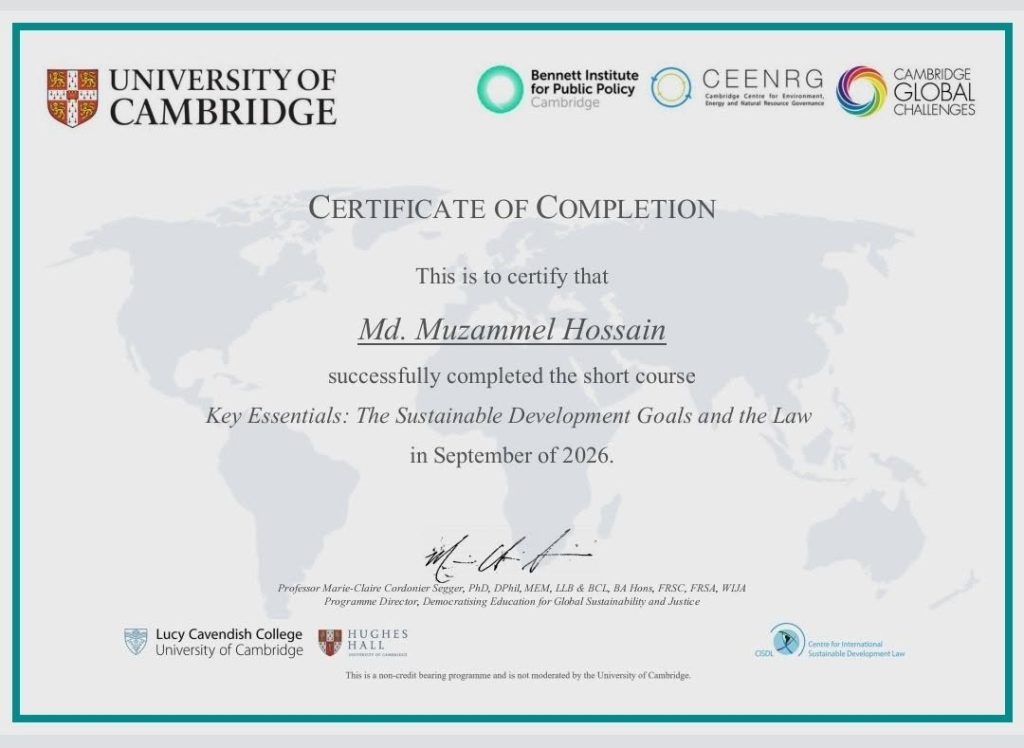
Dr. Md. Muzammel Hossain has successfully completed online training course “the Key Essentials: The Sustainable Development Goals and the Law” offered by Lucy Cavendish College and Hughes Hall at the University of Cambridge.
Climate change is increasingly recognized as a critical driver influencing the mobilization, bioavailability, and ecological behavior of potentially toxic elements (PTEs) in aquatic environments. Dr. Hossain conducted research on climate action using Asian clam (Corbicula fluminea) as a model organism at Jiangsu University, Zhenjiang, Jiangsu, China. In the context of Bangladesh—one of the most climate-vulnerable countries—these impacts are particularly significant due to its dense river network, rapid urbanization, and high dependency on aquatic food resources. The study by Hossain et al. (2024) on PTE accumulation in the invasive Asian clam (Corbicula fluminea) provides an essential baseline to understand how climate-induced changes may exacerbate contamination dynamics and associated human health risks.
Rising temperatures, altered precipitation patterns, and increased frequency of extreme weather events such as floods and droughts directly influence the geochemical cycling of heavy metals in riverine systems. Elevated temperatures can enhance the dissolution of metals from sediments into the water column, increasing their bioavailability to aquatic organisms. Similarly, intense rainfall and flooding events—common under climate change scenarios in Bangladesh—facilitate the runoff of industrial, agricultural, and urban pollutants into rivers, thereby increasing the overall load of PTEs such as lead (Pb), cadmium (Cd), chromium (Cr), and arsenic (As).
Urban river systems, like those examined in the study, are particularly vulnerable to climate variability. During flooding, contaminated sediments are resuspended, leading to increased uptake of metals by benthic organisms such as Corbicula fluminea (Fig. 1). As a filter feeder, this species accumulates contaminants directly from water and suspended particles, making it an effective bioindicator of environmental pollution (Hossain et al. 2024). However, under changing climatic conditions, the rate and extent of bioaccumulation may intensify, posing greater ecological and public health concerns.
Climate change also affects the distribution and invasive potential of C. fluminea. Warmer water temperatures and altered hydrological conditions may facilitate the expansion of this species into new habitats, increasing its ecological dominance and its role as a vector for contaminant transfer within food webs. This expansion can amplify human exposure risks, especially in communities relying on freshwater shellfish as a protein source.
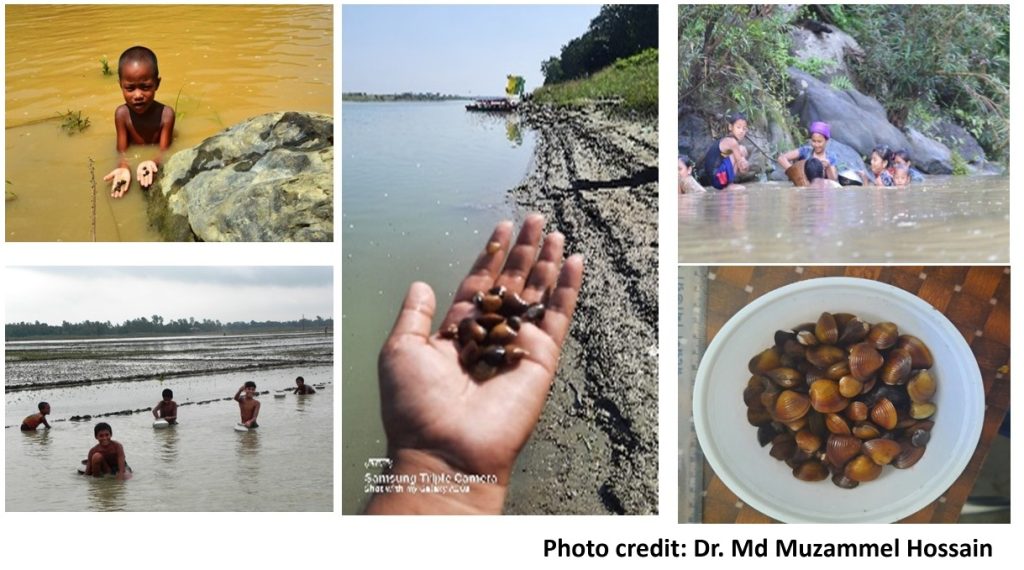
Fig. 1. Asian clam in the environment.
From a human health perspective, the interaction between climate change and PTE contamination is alarming. Increased concentrations of toxic elements in edible aquatic species elevate the risk of chronic exposure through dietary intake. Health risk assessment metrics such as Target Hazard Quotient (THQ), Hazard Index (HI), and Carcinogenic Risk (CR) are likely to show higher values under climate-influenced contamination scenarios. This is particularly concerning in Bangladesh, where food safety regulations and monitoring systems may not be sufficiently robust to address emerging risks (Fig. 2).
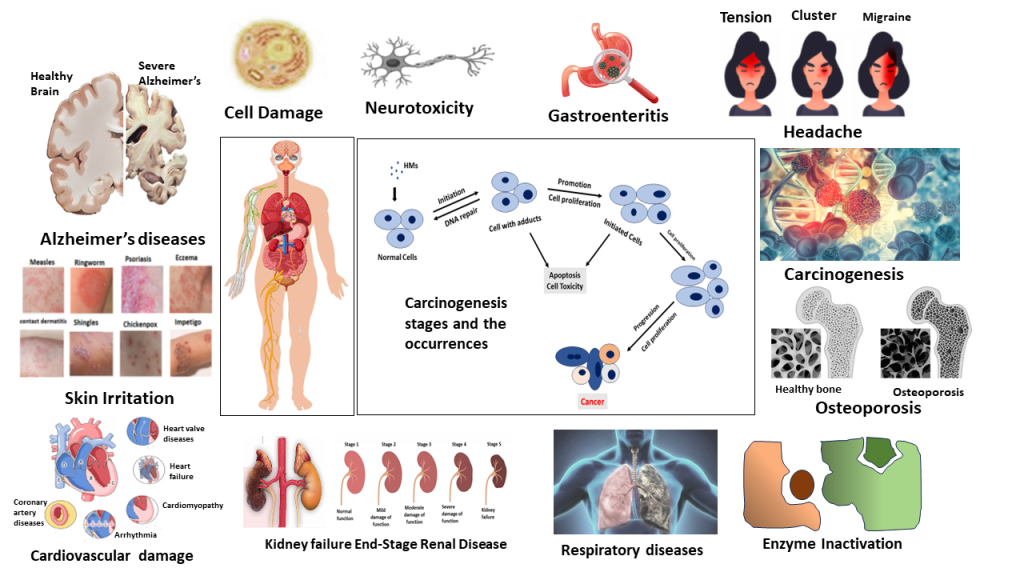
Fig. 2. Represented human health problem due to PTEs contamination in aquatic species.
Furthermore, climate-induced salinity intrusion in coastal and estuarine regions can alter metal speciation and bioavailability, potentially increasing toxicity levels in aquatic organisms. Combined with reduced water flow during dry seasons, pollutant concentrations may become more concentrated, further intensifying exposure risks.
Addressing these challenges requires an integrated approach that combines environmental monitoring, climate adaptation strategies, and public health interventions. Continuous biomonitoring using species like Corbicula fluminea, coupled with advanced analytical and AI-driven risk assessment tools, can provide real-time insights into contamination trends. Policymakers must also consider climate projections when designing pollution control and food safety regulations.
In conclusion, climate change acts as a multiplier of environmental pollution risks by enhancing the mobility, bioavailability, and biological uptake of potentially toxic elements in aquatic ecosystems. The findings of Hossain et al. (2024) underscore the urgent need to integrate climate change considerations into environmental risk assessments and management frameworks in Bangladesh. Failure to do so may result in escalating ecological degradation and significant public health consequences in the near future.
Citation: Hossain MM, Wang, S., Liang, Z., et al., (2024). Potentially Toxic Elements (PTEs) in Invasive Asian Clam (Corbicula fluminea) from Polluted Urban River Areas of Bangladesh and Evaluation of Human Health Risk. Environmental Monitoring and Assessment, 196, 1178 https://doi.org/10.1007/s10661-024-13322-6.
Hossain et al. (2023) conducted a comprehensive investigation into the concentration, distribution, and human health risks of heavy metals in freshwater fish collected from the highly polluted Turag–Tongi–Balu river channel in Bangladesh. This river system, located in the industrial belt near Dhaka, is severely impacted by untreated industrial effluents, municipal waste, and urban runoff, making it a critical hotspot for aquatic contamination.
The study quantified key toxic elements—including lead (Pb), cadmium (Cd), chromium (Cr), nickel (Ni), copper (Cu), and zinc (Zn)—in commonly consumed fish species using standard analytical techniques such as atomic absorption spectroscopy. The results revealed that several heavy metals, particularly Pb and Cd, exceeded international safety thresholds (e.g., WHO/FAO limits), indicating substantial contamination of edible fish tissues.
To evaluate human health implications, the authors applied risk assessment models, including Estimated Daily Intake (EDI), Target Hazard Quotient (THQ), and Hazard Index (HI). The findings demonstrated that:
The study highlights that continuous consumption of contaminated fish from this river system may lead to serious health consequences, including neurological, renal, and carcinogenic effects associated with chronic heavy metal exposure.
Overall, this research underscores the urgent need for:
The authors conclude that without effective intervention, the Turag–Tongi–Balu river system will remain a significant source of toxic exposure, posing an immediate and long-term threat to public health.
Citation: Hossain, M.M., Jahan, I., Nahian, A. A., Zhu, D (2023) Immediate health risk: concentration of heavy metals in contaminated freshwater fishes from the river channel of Turag-Tongi-Balu. Environmental Toxicology. 2023;39(1):120‐134. https://doi.org/10.1002/tox.23959.
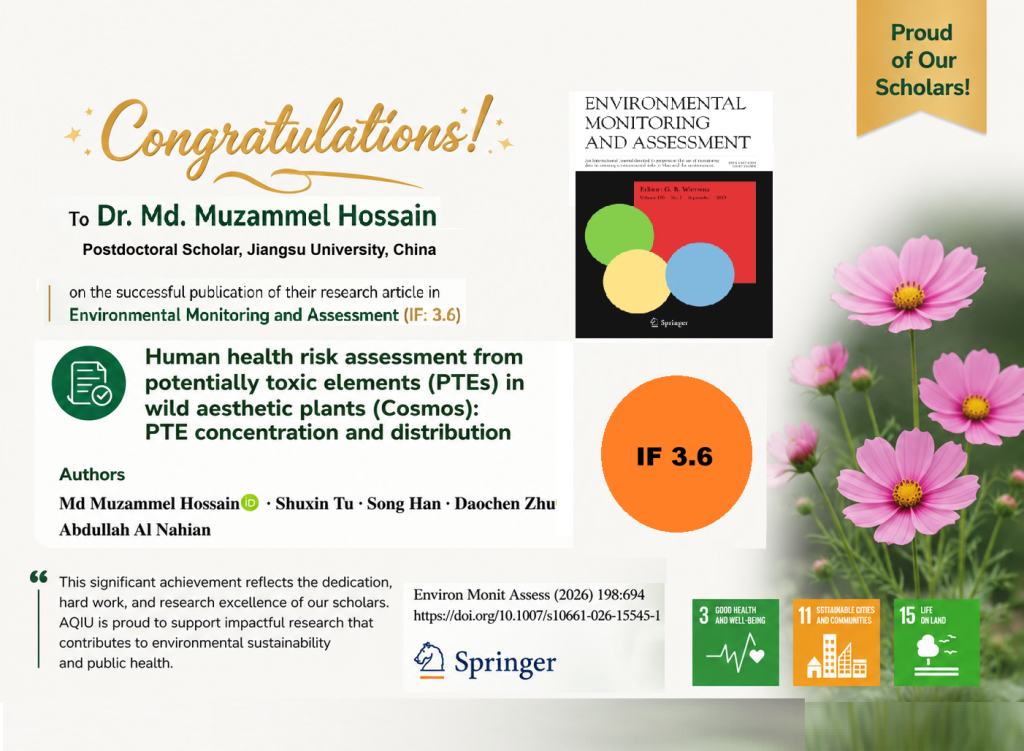
Hossain LAB proudly extends its heartfelt congratulations to Dr. Md. Muzammel Hossain and his esteemed collaborators on the successful publication of their research:
“Human health risk assessment from potentially toxic elements (PTEs) in wild aesthetic plants (Cosmos): PTE concentration and distribution.”
This remarkable achievement reflects outstanding dedication, scientific excellence, and a strong commitment to advancing knowledge in environmental science and public health.
AQIU takes great pride in this accomplishment, which contributes significantly to global research on environmental sustainability, ecological safety, and human health risk assessment.
We commend Dr. Hossain and his research team for their impactful contribution and wish them continued success in their future academic and research endeavors.
Together, we inspire excellence.
Citation: Hossain, M.M., Tu, S., Han, S. et al. Human health risk assessment from potentially toxic elements (PTEs) in wild aesthetic plants (Cosmos): PTE concentration and distribution. Environ Monit Assess 198, 694 (2026). https://doi.org/10.1007/s10661-026-15545-1.
Renowned academician and researcher Dr. Md. Muzammel Hossain has significantly contributed to a groundbreaking study published in the Journal of Food Composition and Analysis, shedding light on the presence of heavy metals and malondialdehyde in Piper betel (betel leaves).
The research warns that the accumulation of toxic metals such as lead (Pb), cadmium (Cd), and arsenic (As) in betel leaves may pose significant health risks to consumers.
Dr. Hossain emphasizes the importance of regular monitoring and regulation to prevent heavy metal exposure through betel consumption.
His findings raise awareness about potential oxidative stress and long-term health consequences associated with contaminated betel leaves.
Citation: Hossain M.M., Tripty, J., Shishir, M.Z.A., Han, S., Zhu, D. (2024). Malondialdehyde and heavy metal contents in Piper betel: Possible Risks of Heavy Metals in Human Health. Journal of Food Composition and Analysis. https://doi.org/10.1016/j.jfca.2024.106540.
Reported : Hossain LAB, Center For Biology, Ecology and Environmental Science
Scholarly article titled “Per- and polyfluoroalkyl substances (PFAS) exposure in biota and remediation strategies: Toxicological and biochemical perspectives” by Hossain et al., (2025) published in the Journal of Hazardous Materials Advances. The article discusses PFAS exposure, its toxicological impacts, and remediation strategies, with a focus on biochemical perspectives.
This comprehensive review by Hossain et al. (2025) examines the pervasive presence of per- and polyfluoroalkyl substances (PFAS) in environmental biota and assesses their toxicological and biochemical impacts. The authors highlight the persistence, bioaccumulation, and widespread distribution of PFAS compounds, emphasizing their potential health risks to wildlife and human populations.
Key Points:
Environmental Distribution and Bioaccumulation: PFAS are detected in various ecosystems, accumulating in aquatic and terrestrial organisms, leading to biomagnification through food chains.
Toxicological Impacts: The review details adverse health effects, including endocrine disruption, immunotoxicity, and carcinogenic potential, linked to PFAS exposure.
Biochemical Mechanisms: The authors explore biochemical pathways affected by PFAS, such as interference with lipid metabolism, oxidative stress induction, and disruption of cellular signaling.
Remediation Strategies: The article evaluates current and emerging remediation techniques, including advanced oxidation processes, activated carbon adsorption, bioremediation, and nanotechnology-based methods, emphasizing the importance of sustainable and effective solutions.
Future Perspectives: Emphasizing the need for stricter regulations and innovative remediation technologies, the authors advocate for further research into biochemical pathways to develop targeted detoxification approaches.
Citation :
Hossain M.M., Nawaz, MZ., Dar, MA., et al. (2025) Per- and polyfluoroalkyl substances (PFAS) exposure in biota and remediation strategies: Toxicological and biochemical perspectives. Journal of Hazardous Materials Advances 17, 100579. https://doi.org/10.1016/j.hazadv.2024.100579.
Reported :
Hossain LAB, Center For Biology, Ecology and Environmental Science.
Center for Biology, Ecology & Environmental Science
Welcome to Hossain LAB, a dynamic hub of scientific innovation and interdisciplinary research dedicated to understanding and solving critical environmental challenges.
We specialize in environmental toxicology, ecology, and sustainable science, working at the intersection of biology and environmental health to create meaningful, real-world impact.
 Our Mission
To advance scientific knowledge and develop innovative solutions for environmental protection, ecological sustainability, and human health through cutting-edge research and collaboration.
 Advancing the Sustainable Development Goals (SDGs) at Hossain LAB.
 Key SDGs We Support
 SDG 3: Good Health and Well-being
 SDG 6: Clean Water and Sanitation
 SDG 7: Affordable and Clean Energy
 SDG 11: Sustainable Cities and Communities
 SDG 13: Climate Action
 SDG 14 &
  SDG 15: Life Below Water & Life on Land Our Focus Areas
 What We Do Join Us in Making a Difference
At Hossain LAB, we believe science can shape a healthier planet. Whether you are a student, researcher, or collaborator, we welcome you to be part of our journey toward sustainable innovation.
Empowering Science for a Sustainable Future