Climate change is increasingly recognized as a critical driver influencing the mobilization, bioavailability, and ecological behavior of potentially toxic elements (PTEs) in aquatic environments. Dr. Hossain conducted research on climate action using Asian clam (Corbicula fluminea) as a model organism at Jiangsu University, Zhenjiang, Jiangsu, China. In the context of Bangladesh—one of the most climate-vulnerable countries—these impacts are particularly significant due to its dense river network, rapid urbanization, and high dependency on aquatic food resources. The study by Hossain et al. (2024) on PTE accumulation in the invasive Asian clam (Corbicula fluminea) provides an essential baseline to understand how climate-induced changes may exacerbate contamination dynamics and associated human health risks.
Rising temperatures, altered precipitation patterns, and increased frequency of extreme weather events such as floods and droughts directly influence the geochemical cycling of heavy metals in riverine systems. Elevated temperatures can enhance the dissolution of metals from sediments into the water column, increasing their bioavailability to aquatic organisms. Similarly, intense rainfall and flooding events—common under climate change scenarios in Bangladesh—facilitate the runoff of industrial, agricultural, and urban pollutants into rivers, thereby increasing the overall load of PTEs such as lead (Pb), cadmium (Cd), chromium (Cr), and arsenic (As).
Urban river systems, like those examined in the study, are particularly vulnerable to climate variability. During flooding, contaminated sediments are resuspended, leading to increased uptake of metals by benthic organisms such as Corbicula fluminea (Fig. 1). As a filter feeder, this species accumulates contaminants directly from water and suspended particles, making it an effective bioindicator of environmental pollution (Hossain et al. 2024). However, under changing climatic conditions, the rate and extent of bioaccumulation may intensify, posing greater ecological and public health concerns.
Climate change also affects the distribution and invasive potential of C. fluminea. Warmer water temperatures and altered hydrological conditions may facilitate the expansion of this species into new habitats, increasing its ecological dominance and its role as a vector for contaminant transfer within food webs. This expansion can amplify human exposure risks, especially in communities relying on freshwater shellfish as a protein source.
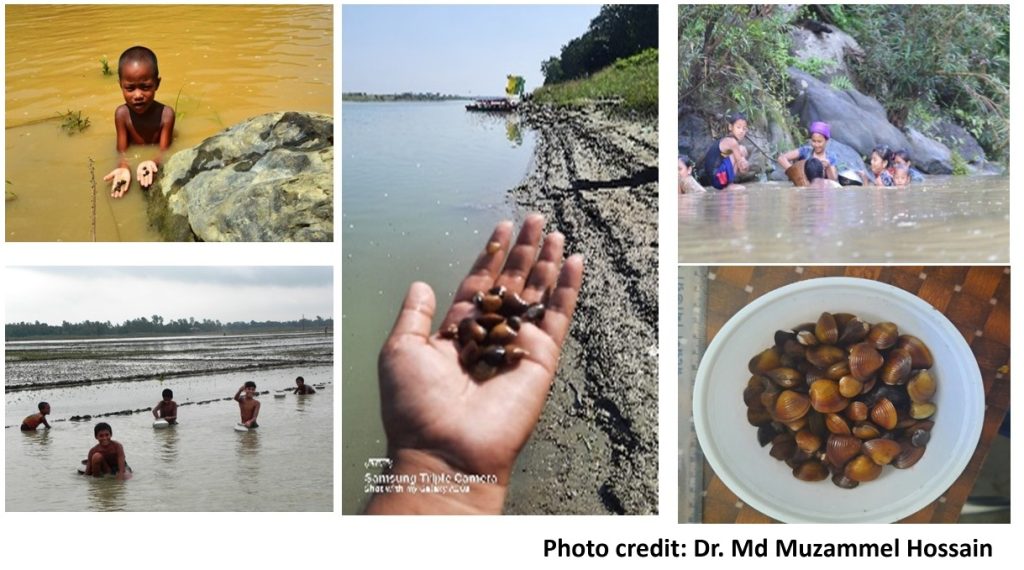
Fig. 1. Asian clam in the environment.
From a human health perspective, the interaction between climate change and PTE contamination is alarming. Increased concentrations of toxic elements in edible aquatic species elevate the risk of chronic exposure through dietary intake. Health risk assessment metrics such as Target Hazard Quotient (THQ), Hazard Index (HI), and Carcinogenic Risk (CR) are likely to show higher values under climate-influenced contamination scenarios. This is particularly concerning in Bangladesh, where food safety regulations and monitoring systems may not be sufficiently robust to address emerging risks (Fig. 2).
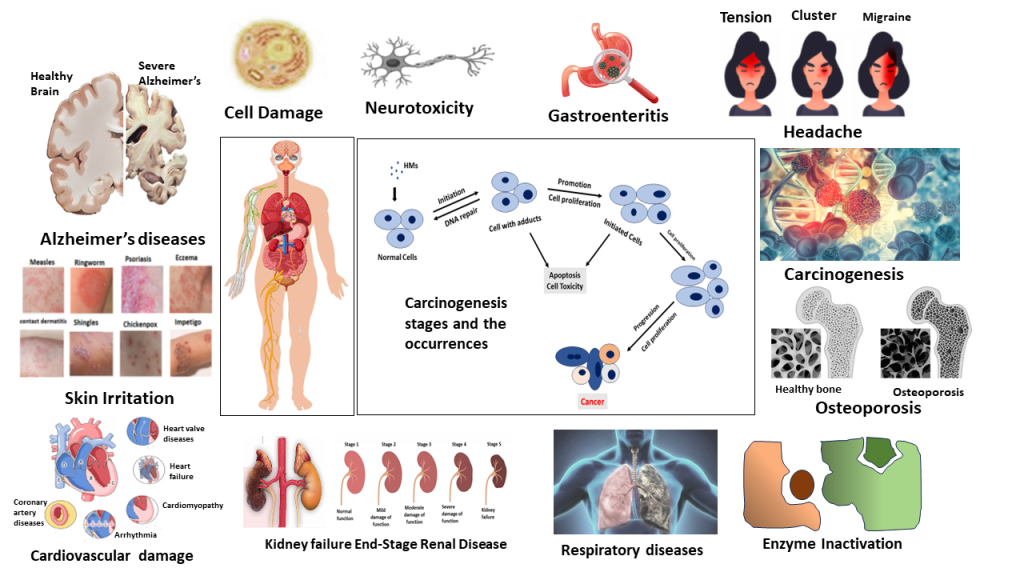
Fig. 2. Represented human health problem due to PTEs contamination in aquatic species.
Furthermore, climate-induced salinity intrusion in coastal and estuarine regions can alter metal speciation and bioavailability, potentially increasing toxicity levels in aquatic organisms. Combined with reduced water flow during dry seasons, pollutant concentrations may become more concentrated, further intensifying exposure risks.
Addressing these challenges requires an integrated approach that combines environmental monitoring, climate adaptation strategies, and public health interventions. Continuous biomonitoring using species like Corbicula fluminea, coupled with advanced analytical and AI-driven risk assessment tools, can provide real-time insights into contamination trends. Policymakers must also consider climate projections when designing pollution control and food safety regulations.
In conclusion, climate change acts as a multiplier of environmental pollution risks by enhancing the mobility, bioavailability, and biological uptake of potentially toxic elements in aquatic ecosystems. The findings of Hossain et al. (2024) underscore the urgent need to integrate climate change considerations into environmental risk assessments and management frameworks in Bangladesh. Failure to do so may result in escalating ecological degradation and significant public health consequences in the near future.
Citation: Hossain MM, Wang, S., Liang, Z., et al., (2024). Potentially Toxic Elements (PTEs) in Invasive Asian Clam (Corbicula fluminea) from Polluted Urban River Areas of Bangladesh and Evaluation of Human Health Risk. Environmental Monitoring and Assessment, 196, 1178 https://doi.org/10.1007/s10661-024-13322-6.